


30 Years is not always the best option
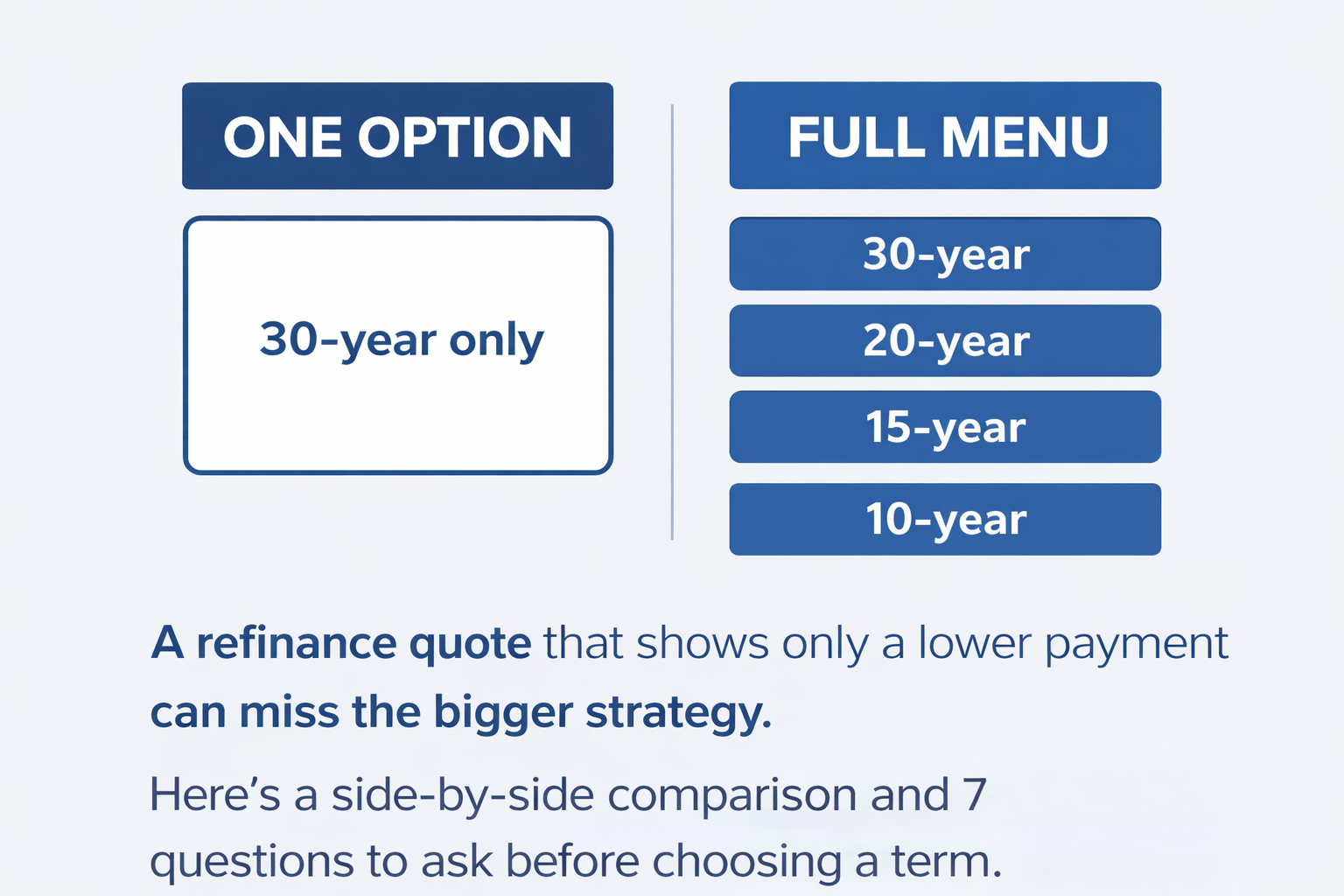
I talked with a client recently who was excited about a refinance quote. The pitch was simple: one rate, one term, one strategy — a new 30-year loan with a lower monthly payment.
And to be clear, saving monthly is great. A 30-year refinance can absolutely be the right move, especially if the goal is payment flexibility and breathing room.
But the quote had a blind spot: it didn’t show what happens when you compare other terms side by side. When we did that, a shorter term made more sense for him, even though the payment wasn’t as “sexy.” Why? Because the amount of interest paid over a shorter window dropped dramatically, and he started paying down principal much faster from the beginning.
The best part in my opinion: less “rate anxiety.”
If rates drop again later, the potential extra savings from refinancing again isn’t nearly as meaningful when your interest cost is already compressed and you’re paying down principal aggressively from day one. In other words, you’re not stuck playing refinance roulette hoping for the perfect rate.
Yes, the payment went up a bit. But the long-term savings were huge (in the hundreds of thousands of dollars). And even if he doesn’t keep the loan for the full term, he’s still building equity faster because more of each payment goes straight to principal early on.
That’s the part most refinance quotes never show you.
Below is the kind of comparison most homeowners never get shown.
What the numbers show on a $235,000 loan
Assumptions used for this illustration
- Loan amount: $235,000
- Monthly escrows (taxes + insurance): $480
- Rates and terms modeled:
- 30-year and 20-year at 5.99%
- 15-year at 5.624%
- 10-year at 4.99%
- Optional curiosity: 8-year (see note)
Monthly payment and total interest (full term)
| Term | Rate | Principal & Interest | PITI (P&I + $480) | Total interest (if kept full term) |
|---|---|---|---|---|
| 30-year | 5.99% | $1,407 | $1,887 | $271,676 |
| 20-year | 5.99% | $1,682 | $2,162 | $168,742 |
| 15-year | 5.624% | $1,936 | $2,416 | $113,416 |
| 10-year | 4.99% | $2,491 | $2,971 | $63,967 |
What jumps out: the 10-year costs more per month, but the interest savings vs. the 30-year are about $207,709 over the full term.
The part most people ignore: what happens in the first 5 years
Most homeowners do not keep the same mortgage for 30 years. That’s why it helps to look at how quickly each option builds equity early on.
Here is the estimated impact after 5 years (60 payments):
| Term | Principal paid in first 5 years | Interest paid in first 5 years | Remaining balance after 5 years |
|---|---|---|---|
| 30-year | $16,349 | $68,097 | $218,651 |
| 20-year | $35,519 | $65,417 | $199,481 |
| 15-year | $57,649 | $58,490 | $177,351 |
| 10-year | $102,947 | $46,536 | $132,053 |
This is why a shorter term can still “win” even if you do not keep the loan for the full term. You’re putting far more into principal right away, which builds equity faster and shrinks the interest you’re exposed to over time.
Optional curiosity: the 8-year scenario
- P&I: about $2,976
- PITI: about $3,456
- Total interest: about $50,696
- Note: this uses an implied rate based on the payment estimate, so treat it as directional, not a locked quote.
Why “one option” refinance quotes are a red flag
A one-option quote isn’t necessarily wrong. It’s just incomplete.
Most quotes lead with the 30-year because it makes the payment look best. That’s helpful if your only objective is monthly cash flow. But a mortgage decision is also a timeline decision — and timeline changes the math.
7 questions to ask before you refinance
What is the real goal?
Lower payment, faster payoff, lower total interest, debt consolidation, removing MI, or stability. Different goals produce different best answers.
Why am I only being shown one term?
Ask for at least: 30-year, 20-year, 15-year, 10-year. You can’t choose a strategy if you can’t see the options.
Does this reset my payoff timeline?
If you refinance into a new 30-year after several years of payments, you might lower the rate but extend the finish line.
If my payment drops, what will I do with the difference?
If the plan is investing, reserves, or paying off higher-interest debt, a 30-year can be strong. If the savings will just disappear, the long-term cost is often bigger than people expect.
How long will I realistically keep this home and this mortgage?
If you might move or refinance again, compare outcomes over 3, 5, 7, and 10 years — not just total interest over 30 years.
What is the break-even point on closing costs?
If costs are rolled in, ask how long it takes for savings to offset them. A refi that looks good monthly can be weak if you won’t keep it long enough.
Will this choice reduce my need to refinance again if rates change?
Shorter terms can make future rate moves less stressful because the interest exposure is already reduced and principal paydown is happening faster from day one.
Bottom line
A 30-year refinance can be a great tool for managing payments. It’s just not the only thing to look at.
The smarter move is to compare the full menu, then choose the option that fits your overall financial strategy — not just the easiest monthly number to say yes to.