


By Jeremy Boillot, Certified Mortgage Advisor | Barrett Financial Group
A New Twist in the Affordability Battle
When you hear “50 Year Mortgage,” it almost sounds like a punchline. Who plans to make house payments for half a century? Yet, the 50 Year Mortgage is becoming more relevant as housing affordability challenges grow.
But the idea is real, and it’s gaining traction as home prices and interest rates keep squeezing first-time buyers. The logic is simple: extend the term, lower the payment, and make housing “affordable” again.
The 50 Year Mortgage is an option worth considering for those looking to enter the housing market.
Understanding the implications of a 50 Year Mortgage can help buyers make informed decisions.
While the 50 Year Mortgage can lower monthly payments, it’s essential to consider the long-term financial implications.
On paper, it seems like the solution everyone’s been waiting for. In practice? It’s a bit more complicated.
The 50 Year Mortgage allows buyers to spread costs over an extended period, but this can significantly increase the total interest paid.
💡 How a 50-Year Mortgage Really Works
A 50-year mortgage doesn’t change what you owe, it just how long you owe it. By stretching the loan over 600 months instead of 360, the monthly payment shrinks slightly, often by $200–$300 compared to a 30-year loan on the same property.
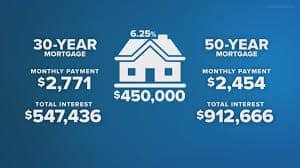
For example, on a $415,000 home with 10% down and a 6.17% rate:
In a 50 Year Mortgage, the trade-off is clear: lower payments versus higher overall costs.
| Term | Monthly Payment | Total Interest Paid | Time to Build $100K Equity* |
|---|---|---|---|
| 30-Year | ≈ $2,277 | ≈ $456,000 | ~ 12 Years |
| 50-Year | ≈ $2,011 | ≈ $845,000 | ~ 30 Years |
*Assumes stable home value and no extra payments.
That’s nearly $389,000 more in interest just for the privilege of paying less each month.
So yes, your budget breathes easier today but your future pays the price.
During the initial years of a 50 Year Mortgage, most payments go toward interest instead of building equity.
Thus, if you opt for a 50 Year Mortgage, be prepared for a longer payoff period.
📉 The Hidden Trade-Off: Time vs. Equity
Lower payments with a 50 Year Mortgage can feel like financial relief, but they often come at the cost of slower equity growth.
It’s crucial to assess whether a 50 Year Mortgage fits your financial strategy and future goals.
With a 50 Year Mortgage, it’s vital to weigh the benefits of lower monthly payments against the long-term costs.
For the first decade or two of a 50-year term, most of your payment barely touches the principal. That means less ownership, less flexibility, and less ability to refinance or sell without eating into profits.
If home prices dip or you need to move within 10 years, you could find yourself owing close to what you paid — or more.
Homeownership should be a path to stability, not a 50-year treadmill.
⚖️ Why the “Affordable” Label Can Mislead
Affordability isn’t just about monthly payment; it’s about sustainability.
A mortgage should fit within your income, your lifestyle, and your long-term goals. When the term stretches half a lifetime, the total cost often outweighs the benefit.
Think about it this way: every dollar spent on interest is a dollar not building your future. A longer term gives you short-term comfort but delays true financial independence.
🏦 The Availability Reality
Despite the buzz, a 50-year mortgage isn’t standard practice yet. Fannie Mae and Freddie Mac don’t buy or guarantee loans longer than 30 years. That means any 50-year product would have to stay on a lender’s books as a portfolio loan.
Portfolio loans can carry stricter terms, higher rates, or prepayment penalties. And because they aren’t easily sold on the secondary market, they may come and go depending on investor appetite.
Translation: even if you hear about a 50-year option, availability could be limited, and flexibility even more so.
🤔 When a 50-Year Term Might Make Sense
There are a few niche situations where an extended term could be used strategically:
- Short-term affordability bridge: A buyer plans to refinance within a few years once rates drop or income rises.
- Multi-generational planning: Families buying together and expecting long-term occupancy may benefit from lower initial payments.
- High-cost markets: In rare cases, it can help first-time buyers get their foot in the door — but only with a clear exit plan.
Even then, it’s not a “set-and-forget” loan. It’s a temporary lever to create flexibility until better terms are available.
🧭 The Smarter Approach: Strategy Over Hype
This is where working with a Certified Mortgage Advisor matters.
I don’t sell programs — I design strategies. My job is to help you weigh today’s payment against tomorrow’s potential and find the balance between comfort and growth.
Sometimes that means exploring creative options like a 40-year term or temporary rate buydown. Other times, it means saying no to a flashy headline if it doesn’t align with your financial goals.
Ultimately, a 50 Year Mortgage can be a strategic choice if approached with caution and planning.
A mortgage should be a wealth-building tool, not a lifetime subscription.
🏁 Bottom Line
The 50 Year Mortgage isn’t a breakthrough — it’s a trade-off. It might make the math work on paper, but it can also keep you in debt far longer and cost hundreds of thousands more over time. Consider your options carefully when looking at a 50 Year Mortgage.
If you’re curious about affordability strategies that actually build wealth, let’s have a conversation. Together, we can design a plan that helps you buy smart, build equity faster, and reach financial freedom sooner — not 50 years later.